

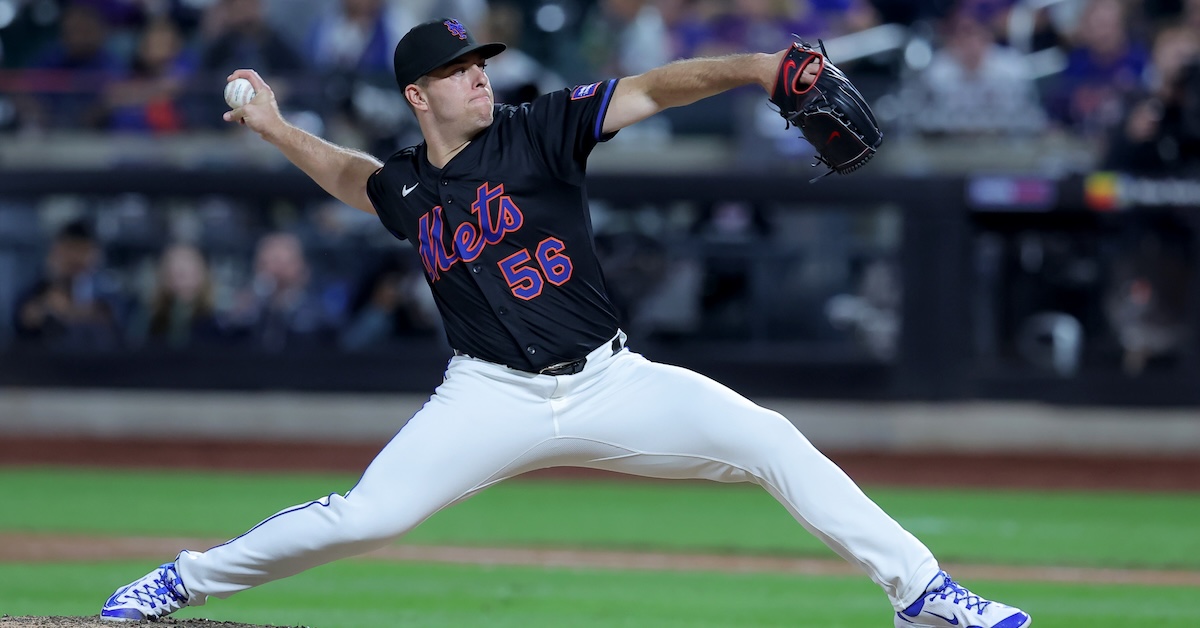

Rest in peace, starting pitcher Ryan Helsley (November 23, 2025 — November 29, 2025.) Last Sunday, a trio of staffers at The Athletic reported that the Tigers, among other teams, were interested in converting Helsley into a starter. Even by the open-minded modern standards of reliever-to-starter conversions, this seemed like a stretch. As Michael Baumann noted when he pondered the possibility, Helsley’s arsenal, comprised almost exclusively of four-seamers and sliders, is about as limited as it gets, and his extreme over-the-top arm angle leaves little room for projection.
On Saturday afternoon, Helsley’s illustrious starting career came to a close. ESPN’s Jeff Passan reported that the Orioles and Helsley had agreed on a two-year, $28 million pact, with an opt-out after the first year. According to Passan, Baltimore expects Helsley to handle the closer job.
Given the Orioles’ competitive ambitions and their considerable payroll space, they were all but a lock to spend a little cash on a backend reliever. President of baseball operations Mike Elias said as much earlier in the offseason, telling reporters that they were working to acquire an “experienced ninth-inning guy.” Following a season in which their bullpen delivered a 4.57 ERA, their top internal options to handle the late innings were Keegan Akin and Kade Strowd — fine pitchers, but not the leverage arms of a team with division-winning aspirations. After swinging a trade for setup man Andrew Kittredge in early November, Baltimore landed its “experienced ninth-inning guy” in Helsley.
Whether he’s up for the task is a reasonable question. After three straight dominant seasons with the Cardinals — book-ended by All-Star selections — Helsley had himself a nightmarish 2025, particularly after St. Louis traded him to the Mets at the deadline; he had a 7.20 ERA and a 5.19 FIP with New York after posting a 3.00 ERA and a 3.55 FIP before the trade. His 89-mph bullet slider was as effective as ever, racking up a 41.6% whiff rate and staying off barrels, but the fastball got rocked. In an interview with The Athletic’s Katie Woo a few days prior to his signing, he gave his theory for why his season went off the rails.
“I felt great, and the Mets’ models showed I was actually having the best stuff of my career, so it didn’t make sense for me to struggle as bad as I did,” Helsley told The Athletic. “But I was being really predictable in certain counts. It was almost a double-confirmation for hitters. They see it with their eyes, and they also had a stat behind it saying I’m more likely to throw this pitch in a certain count. It just gave them that much more comfort in the box, and more conviction.”
When hitters put his fastball in play, they slugged .667. And they had no issues putting it in play. His 17.8% four-seam whiff rate ranked in the 26th percentile of all pitchers with at least 300 fastballs thrown, surrounded by names like Jake Irvin, Miles Mikolas and Bailey Ober. That’s not ideal company.
You Aren’t a FanGraphs Member
It looks like you aren’t yet a FanGraphs Member (or aren’t logged in). We aren’t mad, just disappointed.
We get it. You want to read this article. But before we let you get back to it, we’d like to point out a few of the good reasons why you should become a Member.
1. Ad Free viewing! We won’t bug you with this ad, or any other.
2. Unlimited articles! Non-Members only get to read 10 free articles a month. Members never get cut off.
3. Dark mode and Classic mode!
4. Custom player page dashboards! Choose the player cards you want, in the order you want them.
5. One-click data exports! Export our projections and leaderboards for your personal projects.
6. Remove the photos on the home page! (Honestly, this doesn’t sound so great to us, but some people wanted it, and we like to give our Members what they want.)
7. Even more Steamer projections! We have handedness, percentile, and context neutral projections available for Members only.
8. Get FanGraphs Walk-Off, a customized year end review! Find out exactly how you used FanGraphs this year, and how that compares to other Members. Don’t be a victim of FOMO.
9. A weekly mailbag column, exclusively for Members.
10. Help support FanGraphs and our entire staff! Our Members provide us with critical resources to improve the site and deliver new features!
We hope you’ll consider a Membership today, for yourself or as a gift! And we realize this has been an awfully long sales pitch, so we’ve also removed all the other ads in this article. We didn’t want to overdo it.
Assuming his slider is fine, the merit of the Helsley deal boils down to whether his triple-digit fastball is still a good pitch. The way I see it, there are three possible explanations for its poor performance in 2025. The first is that Helsley was tipping with some sort of visual cue. Helsley told Woo that he believed his hand position “as he was becoming set” revealed whether the pitch would be a fastball or a slider.
“It was pretty obvious,” Helsley told The Athletic. “I’m not the greatest at (spotting pitch tipping), and even I could see it (on film with) the majority of the pitches.”
For whatever it’s worth, it didn’t look that obvious to me. For those on the public side, pitch-tipping analysis often looks like paranoid pattern-matching, like Charlie Day’s Pepe Silvia red string board. There’s little from the center field cameras, at least, that makes it clear. Here’s Helsley’s setup on a fastball that Harrison Bader launched 109 mph to the pull side:

And here is the previous pitch, a slider. Do you see any difference in the setup? To me, there’s no there there.

Here they are right next to each other:

(Helsley changed his setup after this game for the rest of the season, bringing his hands down and holding the ball closer to his body. The results weren’t much better; as Helsley himself said in that interview, it’s hard to make an in-season adjustment.)
While the physical tipping evidence is ambiguous, the count-level predictability is pretty clear-cut. In a broad sense, Helsley maintained a roughly 50/50 usage of his slider and fastball, occasionally tossing in a curveball as a wrinkle. But looking at the overall usage patterns belies the predictability of his pitch selection.
In 0-0 counts, Helsley opted for the heater 57% of the time. In deep hitter counts (2-0, 3-1, and 3-0), that leapt to 75%. Heavy fastball usage in these contexts is somewhat excusable, but Helsley’s full count approach underlined his reliance on the heater in tight spots. Of the 50 pitches thrown in 3-2 counts, 37 (74%) were four-seamers. (Perhaps another reason Bader smashed that 3-2 heater into the stratosphere.)
A similar story could be told with the slider. Heavy slider use in two-strike counts is to be expected, but even in 1-1 counts, Helsley threw it 72 times in 99 opportunities. For a pitcher with essentially two pitches, this type of predictability is lethal, no matter the nastiness of the stuff.
If Helsley’s ineffectiveness comes down to pitch-tipping and count issues, the Orioles have good reason to be confident in a bounce back. But if his stuff is starting to decline, they may have a problem on their hands.
Is there evidence this is the case? If you squint, maybe. Helsley broke out in 2022 with a superhuman 39.3% strikeout rate while tag-teaming the closer role with Giovanny Gallegos. The breakout was fueled by a massive velocity jump — from 2021 to 2022, Helsley’s fastball gained over two ticks, jumping to an average of 99.6 mph. In 2025, that dropped all the way down to… 99.3 mph.
The case for Helsley’s fastball losing its juice, then, would need to be about something other than velocity decline. Here, there is a bit more to latch onto. In that 2022 season, Helsley’s average arm angle on his four-seamer was around 52 degrees. By 2025, that had climbed all the way to 62 degrees with no concurrent improvement to the pitch’s vertical movement.
A fastball’s effectiveness can be largely explained by its vertical movement relative to its release point; more movement from a lower release or lower arm angle makes it tougher for a hitter to pick up. Because the excellent induced vertical break (18 inches) on Helsley’s fastball now comes from a more “vertical” arm angle, it doesn’t have the same deceptive qualities. Once near the top of the scale in terms of Alex Chamberlain’s dynamic dead zone measurements, his fastball has declined to merely “very good.” If Helsley needs to keep hiking his arm angle up each year to maintain the same level of induced vertical break, that could start to look like a concern.
As it stands, this seems to be more of a minor concern than a red flag. The stuff models on FanGraphs — Stuff+ and PitchingBot — both still consider Helsley’s fastball to be a well above-average pitch, even if they agree that the quality has declined slightly from 2022 or 2023. He’s sitting 99 mph, after all — even with poor shape, a four-seamer with that velocity should still play.
Overall, I’m inclined to say that both sides found a good deal here. The reliever market is the first of any position group to take shape in this early offseason, with both Phil Maton and Raisel Iglesias inking deals prior to Helsley. Iglesias is older, but received $16 million for a single year’s work; Maton, a solid middle reliever, got two years and $14.5 million. If this is the range for the second-tier relievers, and if the three top guys — Edwin Díaz, Devin Williams, and Robert Suarez — are in line for a good chunk more, Helsley’s signing starts to look pretty reasonable for the Orioles, especially because he is only one year removed from being in that elite group. For Helsley, it’s another shot at ninth-inning duty, with a chance to hit the market again next offseason, assuming all goes well.
From 2022-2024, Helsley ranked fourth among all relievers in FIP. His stuff is essentially the same as it was during that run. Assuming he sorts out the tipping issues and gets a little less predictable in certain count contexts, the Orioles just signed a high-end closer at an eminently reasonable price – even if it only proves to be for one year.